

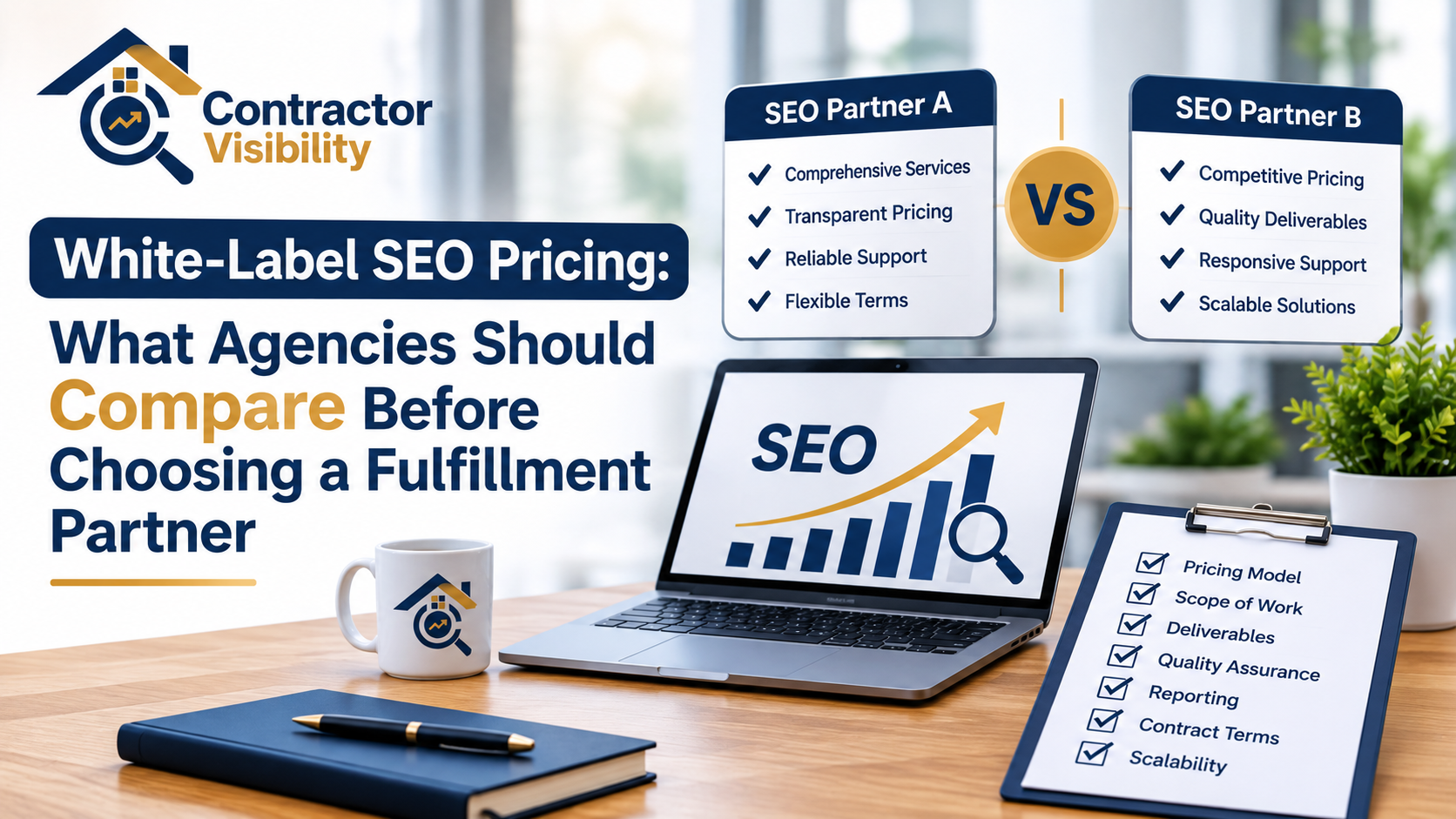
White-label SEO pricing is only one part of the cost of outsourcing SEO. Agencies also need to consider what the provider delivers, how much internal management is required, whether additional charges apply, and how the partnership affects profitability.
A lower monthly fulfillment fee does not automatically mean a better deal. If your team spends additional hours correcting content, managing technical issues, chasing reports, or resolving client complaints, those expenses can quickly reduce the financial benefit of outsourcing.
For digital marketing agencies serving contractors and home-service businesses, the right white-label SEO partner should provide a clear scope of work, dependable execution, transparent reporting, and fulfillment capacity that supports long-term client relationships.
Before choosing a provider, understand how white-label SEO is priced, what each package includes, and how to calculate its actual cost to your agency.
What Is White-Label SEO Pricing?
White-label SEO pricing is the wholesale cost an agency pays an external SEO provider to deliver search engine optimization services under the agency's own brand.
The agency manages the client relationship, determines its retail pricing, and remains responsible for the overall client experience. The fulfillment partner handles the agreed SEO activities behind the scenes.
Depending on the agreement, these activities can include:
Technical SEO audits and implementation.
Keyword research and competitor analysis.
On-page SEO optimization.
Content creation and optimization.
Local SEO and Google Business Profile management.
Link building and authority development.
Performance tracking and branded reporting.
The agency typically charges its client more than the wholesale fulfillment cost. However, the difference between those amounts is not automatically profit. Internal labor, software, account management, and other operating expenses must also be considered.
The Four Common White-Label SEO Pricing Models
White-label SEO providers generally use four pricing structures. Each has different advantages depending on the agency's client volume, project requirements, and preferred budgeting approach.
1. Monthly Retainer Pricing
Monthly retainers involve paying a recurring fee for an agreed scope of SEO services.
This model is suitable for agencies managing ongoing SEO campaigns that require regular optimization, content development, local search improvements, and reporting.
For example, an agency serving an HVAC contractor might use a monthly arrangement covering:
Technical website monitoring.
Service-page optimization.
Local keyword targeting.
Google Business Profile improvements.
Content development.
Monthly performance reporting.
Advantages:
Predictable recurring costs.
Easier campaign budgeting.
Consistent fulfillment capacity.
Suitable for long-term SEO programs.
Potential disadvantages:
Monthly commitments can continue during periods of lower activity.
Additional services may require separate fees.
Agencies need to monitor whether the included scope matches actual requirements.
Before accepting a retainer, request a written breakdown of monthly deliverables and their expected completion frequency.
2. Per-Deliverable Pricing
Under per-deliverable pricing, the agency pays for individual SEO tasks rather than a complete monthly package.
Examples include:
Optimized landing pages.
Blog articles.
Citation building.
Backlink acquisition.
Keyword research.
Website migrations or technical investigations.
This arrangement can work well for agencies with fluctuating workloads or existing in-house SEO teams that need additional production support.
For example, an agency might manage strategy and account communication internally while outsourcing content production and technical implementation separately.
Advantages:
Greater control over individual expenses.
Suitable for one-time projects.
Easier to purchase specialized services.
Useful when demand fluctuates.
Potential disadvantages:
Costs can become less predictable.
Multiple deliverables require additional coordination.
Strategy and execution may become disconnected if responsibilities are unclear.
Request unit pricing, revision allowances, delivery timelines, and acceptance criteria before placing orders.
3. Hourly Pricing
Hourly pricing means paying the provider for the time spent completing agreed SEO tasks.
It can be appropriate for:
Technical investigations.
SEO consulting.
Website migration support.
Complex troubleshooting.
Specialized implementation.
However, hourly pricing requires careful management.
Ask the provider to specify:
Estimated hours.
Work descriptions.
Expected outcomes.
Approval requirements.
Maximum spending limits.
How additional time is authorized.
Without these controls, the agency may find it difficult to forecast monthly expenses.
4. Hybrid Pricing
Hybrid pricing combines a recurring monthly fee with additional charges for work outside the agreed scope.
For example, an agency may pay a monthly retainer for technical SEO, content optimization, and reporting while separately purchasing additional landing pages or migration support.
This structure offers a balance between predictable recurring fulfillment and flexibility.
It can be useful for agencies managing multiple clients with different SEO requirements.
However, the agreement must clearly define which activities are included in the retainer and which trigger additional charges.
What Factors Affect White-Label SEO Costs?

White-label SEO pricing varies because SEO campaigns do not require identical resources.
A small local business with a basic website and limited competition may need a different scope from a multi-location contractor operating across several competitive metropolitan markets.
The following factors commonly influence fulfillment costs.
SEO Scope and Deliverables
The number and type of services included have a direct impact on the proposal.
A package covering keyword tracking and basic on-page recommendations is not equivalent to a managed SEO campaign involving technical implementation, content creation, local optimization, and link building.
Compare the actual work rather than the service names used in the proposal.
Website Complexity and Competition
Larger websites may require more extensive crawling, technical analysis, content optimization, and internal-linking work.
Competitive markets can also require additional strategic research, content development, and authority-building activities.
For example, an HVAC contractor targeting several major cities may require a broader service and location strategy than a single-location company serving a smaller market.
Location and Industry Requirements
Local SEO requirements can vary significantly.
An agency serving one roofing company may need to manage a single Google Business Profile and a focused service-area strategy.
Another agency managing a plumbing business with several physical locations may need additional location research, page optimization, citation management, and reporting.
The number of locations and the geographic scope of the campaign should therefore be included in pricing discussions.
Content and Link-Building Requirements
Content production and link acquisition can represent significant portions of an SEO fulfillment budget.
Ask providers:
How many pages or articles are included?
Who performs research and editing?
Are revisions included?
What link acquisition methods are used?
How is website relevance assessed?
Are publisher or placement fees additional?
Are delivered URLs and campaign records provided?
Do not evaluate link-building proposals solely by the number of links promised. Relevance, editorial standards, transparency, and compliance with search engine policies matter.
Reporting and Account Management
Some providers offer basic automated reports. Others include campaign analysis, strategy discussions, dedicated account management, and branded reporting.
These are different levels of service.
For an agency managing several contractor clients, consistent reporting and communication can reduce the internal time required to maintain accounts.
Clarify whether the provider includes:
Branded reports.
Campaign progress summaries.
Completed-work records.
Performance analysis.
Next-step recommendations.
Scheduled strategy meetings.
Urgent issue escalation.
Compare the Actual Deliverables Behind Every Quote
Two white-label SEO proposals can have similar monthly prices but substantially different deliverables.
An agency should request an itemized scope before comparing providers.
One distinction deserves particular attention: recommendations are not the same as implementation.
A technical SEO audit may identify crawlability or indexing problems, but that does not mean the provider will implement the recommended fixes.
Similarly, a content package may include writing but exclude uploading, formatting, internal linking, and publishing.
Make these responsibilities explicit before signing an agreement.
For agencies needing specialist production support, reviewing white-label content writing services and white-label link building can also help clarify the individual components of an SEO fulfillment program.
Calculate the True Cost of White-Label SEO Fulfillment
The wholesale fulfillment fee is only one component of your agency's total delivery expenses.
To evaluate profitability accurately, distinguish between three financial elements:
- Wholesale fulfillment cost: The amount paid to the external SEO provider.
- Internal delivery cost: The cost of your own team's time, tools, reporting, quality control, and account management.
- Client revenue: The amount your agency receives from the end client.
Your agency's contribution depends on what remains after the relevant delivery expenses have been deducted.
Calculate Agency Contribution Margin
Consider this hypothetical example of an agency selling SEO services to a contractor.
Identify Additional Fulfillment Costs
Before accepting a proposal, check for charges that may not appear in the headline monthly price.
These can include:
Initial onboarding and setup.
Additional website sections or locations.
Content revisions outside the included allowance.
Premium publisher or placement fees.
Additional technical implementation.
Extra reporting or strategy meetings.
Dedicated account management.
Minimum monthly spending requirements.
Rush delivery charges.
Software or dashboard fees.
Ask the provider to identify all recurring and conditional charges in writing.
A transparent pricing agreement makes it easier to forecast expenses and maintain consistent client margins.
Compare Outsourced SEO With In-House Fulfillment
White-label SEO outsourcing is not automatically the best choice for every agency.
The decision depends on client volume, internal capabilities, financial resources, management capacity, and the level of control required.
An in-house team may make sense when an agency has stable demand, sufficient resources, and a strong need for direct operational control.
Outsourcing can be more practical when the agency needs additional SEO capabilities without recruiting and managing every specialist internally.
A hybrid arrangement is also possible. The agency can retain client strategy and account management while outsourcing technical SEO, content, or link-building production.
The right model is the one that supports consistent delivery without creating unnecessary financial or operational pressure.
Evaluate Quality, Communication, and Contract Terms
A low-cost provider can become expensive if your team constantly needs to correct deliverables, chase updates, or manage client complaints.
Before committing, evaluate the partner's quality-control processes and communication standards.
Review the Quality Assurance Process
Request examples of:
Technical SEO audits.
Content deliverables.
Keyword research.
Link-building reports.
Monthly performance reports.
Completed optimization work.
Ask how deliverables are reviewed before they reach your agency.
For example, a content quality-control process should check search intent, factual accuracy, topical relevance, readability, on-page optimization, and adherence to the client brief.
Technical SEO work should include appropriate implementation checks rather than simply documenting recommendations.
Link building deserves particular attention.
Ask how placements are sourced, how relevance is evaluated, whether paid placements are disclosed, and how the provider handles links that do not meet the agreed standards.
Google's spam policies identify manipulative paid links and certain automated link-building practices as violations. Paid advertising and sponsorship links should be appropriately qualified. Review Google's official link spam policies before approving a provider's link acquisition process.
Establish Communication Standards
A dependable fulfillment partnership should have clearly defined communication responsibilities.
Establish:
Who manages your agency account?
What are the expected response times?
How are urgent technical issues escalated?
How frequently are campaign updates provided?
Can reports carry your agency's branding?
Who handles revisions?
Who answers client-facing questions?
How are delayed deliverables communicated?
A consistent communication process becomes particularly important when managing several contractor accounts simultaneously.
Review Contract Terms and Ownership
Before signing, review the agreement for:
Minimum commitments.
Cancellation notice periods.
Payment schedules.
Confidentiality provisions.
Intellectual property ownership.
Content and report ownership.
Account access.
Data handling.
Revision policies.
Responsibilities after termination.
Your agency should understand what happens to campaign files, content, reports, and account access if the partnership ends.
The agreement should also establish that the provider will not bypass your agency to solicit your clients.
Use a Scorecard to Compare White-Label SEO Partners
Comparing proposals becomes easier when every provider is evaluated against the same criteria.
Use the following framework to assess potential partners.
Score each provider from 1 to 5, where:
1 = Inadequate.
2 = Below expectations.
3 = Acceptable.
4 = Strong.
5 = Excellent.
You can also assign greater importance to specific factors.
For example, an agency managing competitive roofing and HVAC accounts may place greater importance on local SEO expertise, technical implementation, and content quality than on the lowest available price.
The objective is not simply to identify the cheapest proposal. It is to find the provider offering the strongest combination of cost, delivery quality, transparency, and operational fit.
Choosing an SEO Fulfillment Partner for Contractor Clients

Agencies serving contractors and home-service businesses should also consider whether their fulfillment partner understands local search requirements.
SEO for a roofing company may involve different service pages, location targets, and competitive priorities than SEO for a plumbing or HVAC business.
A contractor-focused fulfillment partner should understand:
Service-area targeting.
Location-specific landing pages.
Local keyword research.
Google Business Profile optimization.
Local citation management.
Industry-specific content requirements.
Local competitor analysis.
Lead-focused reporting.
For example, an HVAC campaign may require content around heating and cooling services, seasonal demand, and the specific cities served.
A plumbing campaign may need to distinguish emergency plumbing searches from general installation and maintenance searches.
A roofing campaign may require separate strategies for residential roof replacement, storm damage, inspections, and commercial roofing.
The fulfillment partner should understand these differences rather than applying identical optimization tasks to every local business.
Contractor Visibility provides white-label SEO fulfillment for agencies serving home-service businesses, with services covering technical SEO, local SEO, content, link building, and reporting.
Agencies can explore the available white-label SEO services to understand how the fulfillment offering aligns with their client requirements.
Frequently Asked Questions
1. How much does white-label SEO cost?
White-label SEO pricing depends on campaign scope, website complexity, competition, location requirements, content production, link building, and reporting. Providers may charge monthly retainers, per-deliverable fees, hourly rates, or hybrid pricing. Agencies should request itemized proposals before comparing costs.
2. What is included in white-label SEO pricing?
Depending on the package, white-label SEO pricing may include technical SEO, keyword research, on-page optimization, content creation, local SEO, link building, and branded reporting. Some providers include strategy and implementation, while others charge separately for individual services.
3. Is white-label SEO profitable for digital marketing agencies?
White-label SEO can support agency profitability when the client retail price exceeds the complete delivery cost. Agencies should account for wholesale fulfillment, internal labor, software, reporting, account management, and other expenses before calculating their contribution margin.
4. How should agencies compare white-label SEO providers?
Agencies should compare pricing transparency, deliverables, implementation responsibilities, quality assurance, communication, reporting, contract terms, industry knowledge, and scalability. Evaluating every provider against the same scorecard helps prevent price from becoming the only selection criterion.
5. Is white-label SEO better than hiring an in-house team?
Neither option is universally better. In-house SEO provides greater direct management control, while outsourcing can provide additional fulfillment capacity without requiring the agency to recruit every specialist. The best approach depends on client volume, available resources, and delivery requirements.
6. Are white-label SEO packages suitable for contractors?
Yes. White-label SEO packages can support agencies managing roofing, HVAC, plumbing, electrical, and other home-service businesses. The scope should account for local search competition, service-area targeting, location pages, Google Business Profile optimization, and industry-specific content.
7. What should agencies ask before signing a white-label SEO agreement?
Ask for an itemized scope, sample deliverables, quality-control procedures, communication expectations, additional charges, contract conditions, ownership terms, and reporting examples. Clarify who implements SEO recommendations and who is responsible for correcting errors.
8. Can agencies use white-label SEO for multiple clients?
Yes. Agencies can use white-label fulfillment across multiple accounts, provided the provider has sufficient capacity and a clear process for managing separate campaign requirements. Ask about onboarding, account allocation, delivery timelines, reporting, and volume-based pricing.
Choose a White-Label SEO Partner That Supports Your Agency
The best white-label SEO partner is not necessarily the cheapest provider or the one offering the largest package.
It is the provider that delivers the right scope of work, maintains consistent quality, communicates clearly, and fits your agency's financial and operational requirements.
Before making a decision, compare complete delivery costs, review sample work, understand contract terms, and evaluate whether the provider can support your clients' specific industries.
For agencies serving contractors and home-service businesses, specialist SEO fulfillment can make it easier to extend service capabilities without building every part of the delivery operation internally.
Looking for white-label SEO fulfillment for your contractor clients? Explore Contractor Visibility's white-label SEO services and discuss your agency's requirements with the team.
A well-evaluated partnership can help your agency manage fulfillment more efficiently while keeping quality, costs, and client expectations under control.