

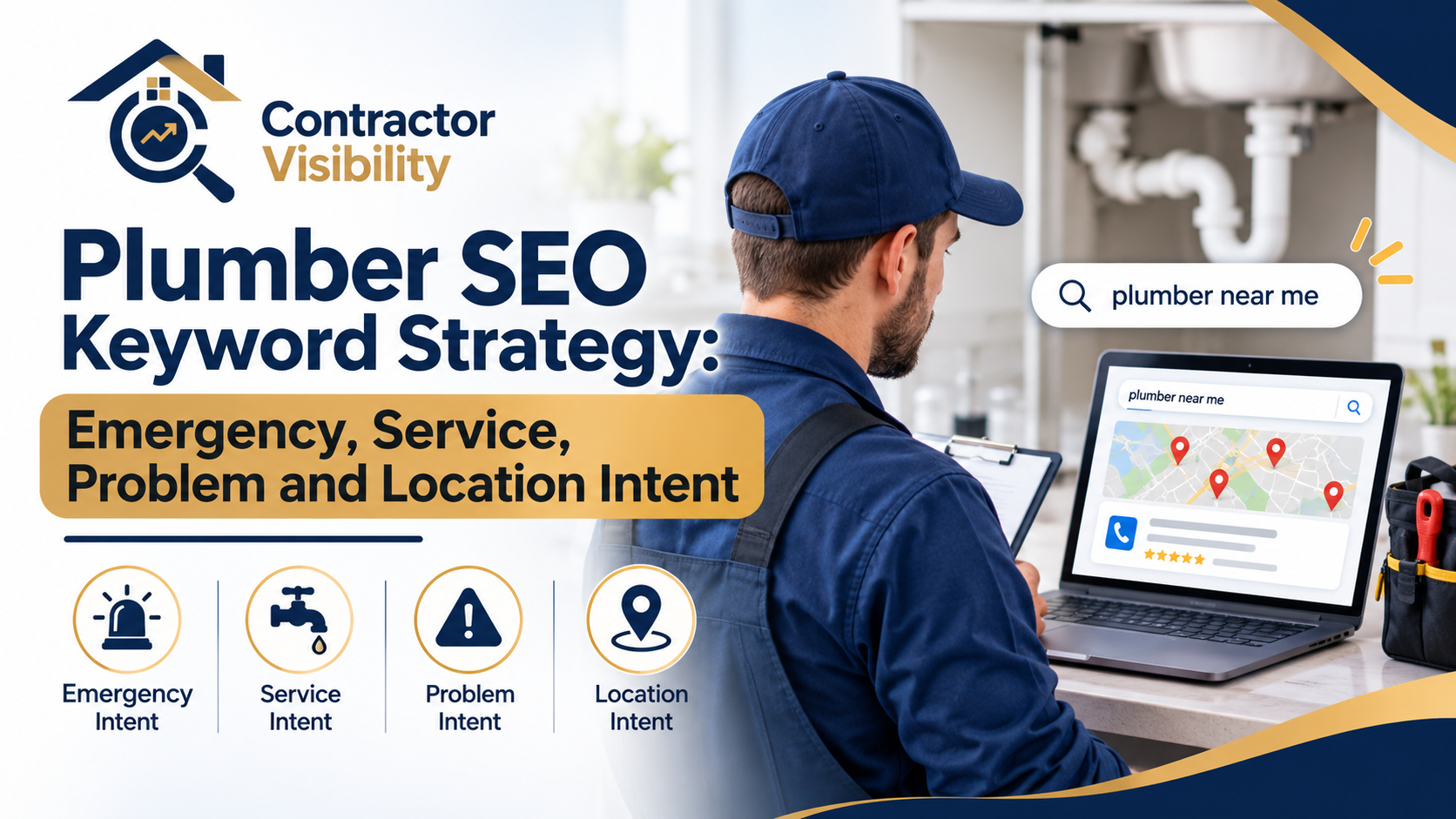
A plumber SEO keyword strategy works when every keyword has one job: a specific page or profile that answers what the searcher needs right now. The practical way to build one is to organise plumbing keywords into four intent groups: emergency, service, problem and location. Each group should have the asset best placed to serve it, whether that is a Google Business Profile, service page, blog post or service-area page.
This approach is particularly useful for agencies managing plumbing SEO campaigns. It helps prevent keyword cannibalisation, improves website structure and connects search visibility with meaningful actions such as phone calls and quote requests.
Why Intent Beats Volume for Plumbing Keywords
Two people can both need a plumber and still need completely different pages. Someone searching for "burst pipe repair near me" wants a phone number in seconds. Someone searching for "why is my water bill so high" wants an explanation first and a plumber second.
Google's guidance prioritises helpful, reliable content created for people rather than content designed primarily to manipulate search rankings. For plumbing website SEO, that translates into a straightforward rule: match the page to the need behind the query, then make the next step obvious.
That's also why targeting a broad term like "plumber" with one page rarely works. The need is unclear, local competition is crowded, and the page ends up trying to be an emergency page, a service menu and a city page at once. Plumber lead generation improves when each page has a distinct purpose and a clear action: call, book or read the next relevant page.
The Four Intents and Where Each One Belongs
Use this table as the foundation of your keyword map. The keywords below illustrate search patterns; they are not researched search-volume figures. Validate demand for each client's market using Google Search Console and your preferred keyword research tool.

Emergency intent: This is usually the smallest group and often the most valuable because searchers are not comparing several options for long; they need help. Give emergency searches their own page with a tap-to-call number visible on mobile, the situations the company handles and the areas it covers. State availability honestly: only say "24/7" if the company genuinely answers around the clock. Keep emergency content separate from routine service pages so neither page is pulled in two directions.
Service intent: Create a separate page for each core service when the searches behind them are genuinely different. "Water heater installation" and "sewer line repair" deserve their own pages. "Water heater repair," "water heater service" and "fix hot water heater" may belong on the same page if they satisfy the same search need. Give each page one primary keyword, treat variations as supporting terms, and merge pages that would compete for the same query. This helps avoid keyword cannibalisation.
Problem intent: These searchers describe symptoms, not services: "toilet keeps running," "low water pressure" and "water leaking under the sink." A helpful post or FAQ can answer the question, explain possible causes, clarify when a professional may be needed and link to the matching service page. Expect these pages to build trust and earlier-stage visibility rather than generate instant calls in every case.
For example, a plumbing company could publish an educational article about potential sources of lead in household plumbing. The EPA's guidance on lead in drinking water explains how lead can enter drinking water through plumbing materials, including pipes, faucets and fixtures. For more detail, the EPA also provides information on sources of lead in drinking water. These government resources can help support accurate educational content on plumbing-related problems.
Location intent: This is where local SEO for plumbers and the plumber Google Business Profile do the heavy lifting. Google's guidance on how to improve local rankings identifies relevance, distance and prominence as the main factors influencing local results. Review count and review score can also contribute to local prominence, alongside the business's position in web results.
Google's Business Profile guidelines also distinguish between businesses that receive customers at their address and service-area businesses. For example, a plumber working from a home address who does not serve customers at that address should hide the address and list the areas served instead. Build service-area pages only for places the company genuinely serves, and give each page something unique: the services offered there and details the client can verify. Simply swapping the city name on duplicate pages is not a local SEO strategy.
A Simple Framework: One Keyword, One Job

Agencies can use this five-step workflow to create and maintain a clear keyword map for each plumbing client.
Collect. Pull queries from Google Search Console, Google autocomplete, the client's job list and the questions office staff frequently hear on calls.
Tag intent. Label each keyword as emergency, service, problem or location. If a keyword appears to fit two groups, review the actual search results and decide which page best satisfies the query.
Assign one asset. Each keyword cluster gets one primary destination: the Google Business Profile, an emergency page, a service page, a blog post or a service-area page.
Connect. Link problem posts to service pages, service pages to the areas served, and the Google Business Profile to its most relevant landing page.
Review. Check Search Console monthly for queries landing on the wrong page, overlapping pages and changes in search performance. Fix keyword mapping issues before adding more pages.
Worked Example: A Plumbing Company Serving Multiple Locations
This is a hypothetical illustration, not a client result. Imagine a plumbing company serving a mid-sized U.S. city and two nearby suburbs. It offers emergency repairs, water heater work and drain cleaning.
Its keyword map could look like this:
"Emergency plumber [city]" goes to the emergency page, and the Google Business Profile links to that page.
"Water heater repair [city]" goes to one dedicated water heater repair page.
"Tankless water heater installation" gets its own page because buyers research installation differently from repair.
"Water heater not producing hot water" becomes a blog post that links to the repair page.
"Plumber in [suburb]" gets a suburb page only if the company actually serves that location and the page can provide specific, useful information about its services there.
The homepage covers the brand and the core "plumber [city]" term. Other pages target distinct services, problems and locations without competing unnecessarily. If an audit finds three separate water heater pages chasing the same query, the better solution may be to merge overlapping content rather than add a fourth page.
Plumbing Website SEO Checklist Before You Publish
Before publishing a new page or updating an existing one, use this checklist:
Every target page has one primary keyword and a distinct search intent.
The phone number is tap-to-call and visible on mobile without scrolling.
Emergency availability is described accurately.
Service pages explain the process, the areas served and licensing or insurance details the client can verify.
Problem-focused posts link to relevant service pages, and service pages link back to useful guides.
The Google Business Profile has the correct primary category, services, hours and service area.
The business address is hidden if the company does not serve customers at that address.
The client requests reviews after completed jobs and responds to them.
Google Search Console is connected so the agency can monitor actual queries, impressions and landing-page performance.
A consistent keyword map gives agencies a practical foundation for managing plumbing SEO across multiple services and locations. It also makes content planning more focused: each new page has a defined purpose instead of competing with existing content.
If your agency serves plumbing clients and would rather not manage the research, content and optimisation workflow entirely in-house, Contractor Visibility's plumbing content writing services can support your content production under your agency's brand. You can also explore white-label local SEO services to support local search campaigns.