
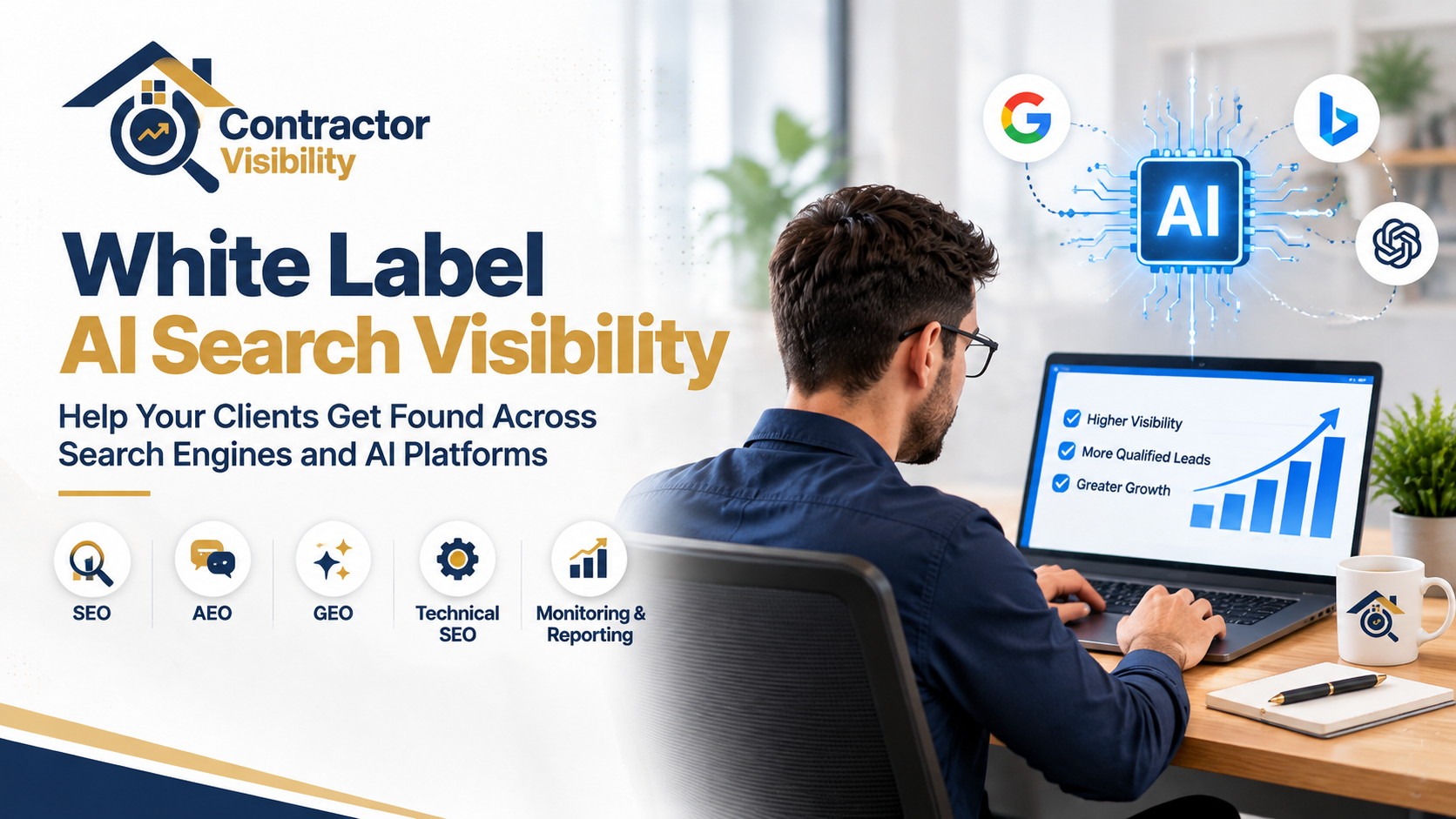
White-label AI search visibility is the delivery of AI-search optimization work by a specialist provider while the agency keeps the client relationship, branding, pricing and communication under its own control.
For an agency, that can include much more than tracking whether a business appears in ChatGPT or Google AI Overviews. A properly scoped set of AI search visibility services may combine AI visibility auditing, AEO and GEO content work, technical SEO, entity and brand optimization, authority development, prompt monitoring, competitor analysis and white-label reporting.
The important question is not simply whether a provider offers "AI SEO." It is what work is actually performed, what the agency receives, how visibility is measured and which parts of the campaign remain the agency's responsibility.
What Is White-Label AI Search Visibility?

White-label AI search visibility is a fulfillment service that helps agencies improve how clients' businesses and website content can be discovered and understood across traditional search engines and AI-powered search experiences.
It brings several related disciplines together:
SEO: Helps search engines crawl, understand, and index useful website content.
AEO: Makes information clear and useful for direct questions and answer-based search experiences.
GEO: Focuses on improving a brand's discoverability and representation in generative AI experiences.
Technical SEO: Addresses accessibility, indexability, site structure, and other technical foundations.
Monitoring and reporting: Tracks selected visibility indicators and documents completed work.
For an agency serving contractors, this work might involve improving an HVAC company's AC repair pages, clarifying its service areas, strengthening useful answers about emergency repairs, and checking whether important website content is accessible to search crawlers.
The goal is not to guarantee that an AI platform will mention a business. It is to improve the quality, clarity, relevance, and accessibility of the information that search systems may use.
What Services Should an AI Search Visibility Package Include?

A well-defined white-label AI SEO service should explain what the provider researches, what it changes, and what the agency receives.
1. AI visibility audit and baseline research
The campaign should begin with an assessment of the client's current search presence and relevant AI-generated responses.
An audit may include:
Reviewing important service, location, and informational pages.
Identifying relevant customer questions and search prompts.
Sampling brand mentions and website citations across selected platforms.
Comparing observed visibility with relevant competitors.
Identifying content, technical, and business-information gaps.
Establishing a baseline for future reviews.
For example, an agency managing a Dallas HVAC company could examine questions about emergency AC repair, system replacement, maintenance, and service availability. The audit should record which prompts were tested, which platforms were reviewed, and when the observations were collected.
Typical deliverable: An audit report, prompt set, competitor observations, and prioritized recommendations.
2. AEO and GEO content optimization
AEO and GEO overlap, but they are not interchangeable terms. AEO emphasizes clear answers to specific questions. GEO focuses more broadly on how a brand and its information are represented in generative search experiences.
A fulfillment partner may:
Improve existing service and location pages.
Develop useful answers to common customer questions.
Create content briefs and supporting blog content.
Clarify headings, definitions, service descriptions, and explanations.
Strengthen topical coverage around important services.
Review factual claims and add credible references where appropriate.
Consider a Phoenix roofing contractor. Useful content could explain roof replacement factors, signs of storm damage, material options, and what homeowners should ask before hiring a roofer. The information should be accurate, locally relevant where appropriate, and connected to the company's actual services.
Typical deliverable: Content briefs, revised pages, new content, FAQ recommendations, and an optimization log.
3. Entity, brand authority, and digital PR
Search systems need to make sense of a business's identity and the services it provides. Conflicting company details or vague service descriptions can make that understanding harder.
Depending on the agreed scope, entity and authority work may involve:
Reviewing business name, contact details, and service information.
Clarifying company descriptions and service categories.
Improving author, company, and about-page information.
Checking consistency across relevant business profiles.
Identifying credible industry publications and digital PR opportunities.
Reviewing relevant third-party brand mentions.
For a Houston plumbing company, its website should clearly describe its plumbing services, service areas, and business identity. Genuine industry coverage can add useful context, but unrelated paid mentions and bulk links are not substitutes for credible authority.
Typical deliverable: Business information review, entity recommendations, digital PR opportunities, and completed outreach updates when outreach is included.
4. Technical SEO and AI crawler accessibility
Content cannot contribute to search visibility if important pages are inaccessible, blocked, or not eligible for indexing.
Technical work may cover:
Crawlability and indexability.
Robots.txt and relevant crawler access.
XML sitemaps and canonical URLs.
Internal linking and site architecture.
Mobile usability and page performance.
Relevant structured data.
Technical errors affecting priority pages.
Google's guidance states that the SEO fundamentals remain relevant to AI Overviews and AI Mode. A page must meet normal Search eligibility requirements; Google does not require special AI schema or additional technical requirements for these features. Read Google's guidance on AI features and website visibility.
For ChatGPT Search, OpenAI identifies OAI-SearchBot as the crawler used to surface websites in ChatGPT search results. Website owners can manage this crawler separately from GPTBot through their access settings. Read OpenAI's crawler documentation.
Typical deliverable: Technical audit, crawler-access review, prioritized fixes, and implementation notes or completed changes according to the contract.
5. AI visibility monitoring and reporting
Monitoring helps agencies review whether the work is improving the client's overall search presence and how the business appears in selected AI experiences.
A reporting process may track:
Prompts tested and platforms reviewed.
Observed brand mentions and website citations.
Competitors appearing in sampled responses.
Accuracy of business and service descriptions.
Content and technical work completed.
Organic search traffic and conversions from available analytics.
AI-generated responses can vary across prompts, locations, dates, and platforms. A report should therefore document its testing method and treat AI mention or citation tracking as directional evidence—not a fixed ranking position or guaranteed outcome.
Typical deliverable: A prompt-tracking record, visibility observations, completed-task summary, and recommendations for the next reporting period.
What Should Agencies Receive From a Fulfillment Partner?
The scope should make responsibilities clear before the campaign begins.
Not every provider includes every activity. Confirm whether content writing, implementation, publishing, outreach, tracking tools, revisions, and reporting are included or billed separately.
How Can Agencies Evaluate a White-Label Provider?
Before selecting a partner, ask these questions:
What is included? Request a written list of deliverables, exclusions, and expected turnaround times.
Who implements changes? Confirm whether the provider makes website updates or supplies recommendations for the agency to implement.
How is visibility measured? Ask which platforms and prompts are monitored, how often they are checked, and how results are recorded.
Who approves content? Establish review steps for brand voice, technical accuracy, service details, and local information.
How is reporting branded? Confirm whether reports can be presented under the agency's identity and whether raw work logs are available.
What happens when priorities change? Agree on how new client requirements, revisions, and technical dependencies are handled.
For agencies serving roofing, HVAC, plumbing, and other home-service businesses, local accuracy deserves particular attention. Service areas, emergency availability, licensing statements, and descriptions of actual services should be verified with the client before publication.
Agencies looking to expand their offering can review Contractor Visibility's white-label complete AI search visibility services to understand the available fulfillment solution.
Frequently Asked Questions
Is white-label AI search visibility the same as traditional SEO?
No. It builds on traditional SEO but may also include AEO, GEO, AI visibility monitoring, and other work focused on how businesses are represented in AI-powered search experiences.
Do Google AI Overviews require special schema?
No. Google's current documentation says there are no special schema requirements or additional technical requirements for appearing in AI Overviews or AI Mode. Normal Search eligibility and SEO best practices still apply.
Can agencies outsource AEO and GEO services?
Yes. Agencies can outsource research, content optimization, technical recommendations, implementation, monitoring, and reporting. The exact responsibilities depend on the provider's scope of work.
How is AI search visibility measured?
It can be assessed by recording brand mentions, website citations, competitor appearances, and response accuracy across a defined set of prompts and platforms. These observations should be dated and treated as directional because responses can change.
Does a white-label provider guarantee AI citations?
A provider should not guarantee citations or placements in AI-generated answers. Platforms control their own systems and responses. A credible partner should explain its process, deliverables, measurement methods, and limitations.
Expand Your Agency's AI Search Capabilities
White-label AI search visibility can help agencies extend their services without building every specialist capability internally. The value depends on a clearly defined scope, accurate content, sound technical SEO, credible authority work, and transparent reporting.
If your agency serves contractors or home-service businesses, explore Contractor Visibility and its white-label complete AI search visibility services to review the available support for your agency's fulfillment needs.