
 William

A contractor does not need more traffic. They need the right jobs.
An HVAC owner may get 40 extra calls in July and still be unhappy. If most callers want a $99 tune-up when the crew is booked solid, the campaign is not solving the owner’s problem. Meanwhile, three enquiries about replacement systems could be much more valuable. That difference—between visibility and useful demand—is where good home service SEO begins.
SEO for home services helps contractors appear in Google Search and Maps for the services and communities they actually cover. For agencies, the job is larger than improving rankings: identify the right demand, build pages that answer it, make it easy to contact the business, and connect marketing activity to qualified calls and booked work.
This guide covers local search, keyword mapping, on-page and technical SEO, content, reviews, link earning, conversion measurement, reporting, and the agency workflow that holds it together.
What makes home service SEO different?
Most home service purchases are geographically constrained. The buyer cares whether the company can arrive, whether it is trustworthy, and whether it handles the exact problem. Search intent also changes dramatically: “furnace making noise” is research; “emergency furnace repair near me” is a request for help now.
- Local visibility depends on relevant organic pages and an accurate Google Business Profile.
- Urgent searches require fast mobile experiences and prominent, honest contact options.
- Service-area coverage must reflect where crews actually travel, not a wish list of nearby cities.
- A ranking report without qualified-lead feedback misses the business outcome.
Start with the contractor’s economics, not a keyword tool.
At kickoff, ask which jobs generate the strongest contribution margin, which services are overbooked, where technicians are dispatched, what seasonal demand looks like, and which jobs the owner does not want. Record the average ticket, approximate gross margin, capacity, close rate, and lead qualification rules where the client can supply them.
Example: a roofing contractor may want full replacements, not small patch repairs. Both have search demand, but they require different pages, calls to action, and reporting. The agency should not optimise them as though every click carries the same value.
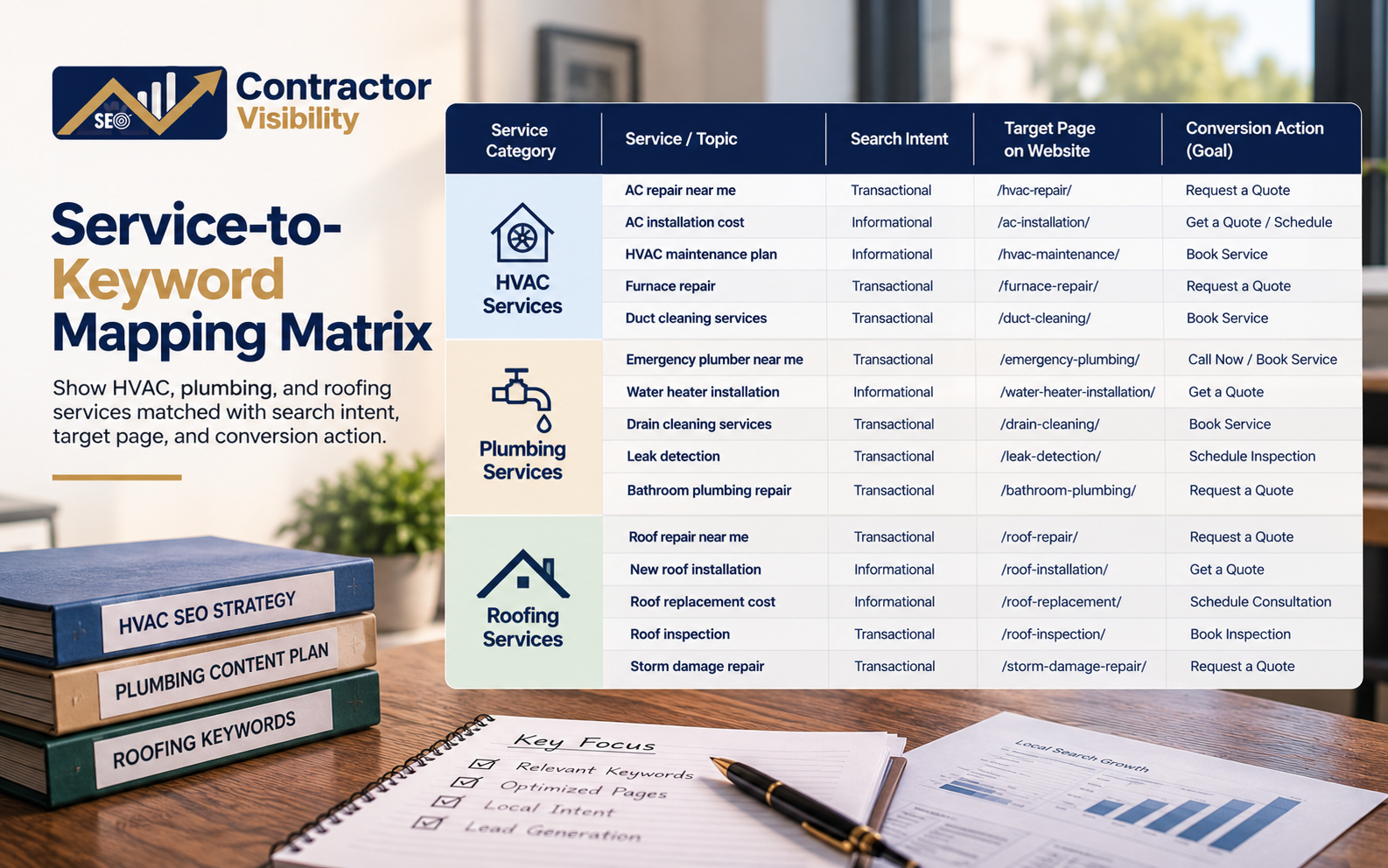
Build a service-to-intent keyword map.
Create one row for each meaningful intent cluster. Include service, urgency, city or region, likely searcher question, intended URL, primary conversion, and content owner. Validate intent in local search results and use Search Console data to find existing traction.
Illustrative mapping: “AC repair” → core repair page → call; “AC repair Austin” → repair page with real Austin coverage or a substantial local page → call; “heat pump vs furnace” → comparison guide → request an estimate; “burst pipe near me” → genuine emergency plumbing page → tap to call.
Do not create two near-identical pages merely because one keyword says “AC repair” and another says “air conditioner repair". Consolidate overlapping intent where appropriate. Likewise, do not mass-produce city pages by swapping location names.
Audit the local competitive landscape.
Check the map pack and organic results for priority services from the client’s target communities. The relevant competitors are the businesses that rank for those searches—not necessarily the names the owner thinks of first. Compare profile categories, review freshness, page usefulness, evidence of local work, mobile conversion paths, and legitimate links.
Get Google Business Profile fundamentals right.
Choose an accurate primary category, add relevant services, publish genuine team and jobsite photos, maintain accurate hours, and make sure the business name and contact details match real-world operations. Request honest reviews from customers after completed work, without incentives or selective solicitation.
A service-area business that does not receive customers at its address should hide that address. Google currently allows up to 20 defined service areas and advises that the overall area generally remain within about two hours’ drive of the business base; exceptions may apply. Do not use virtual offices or duplicate profiles to manufacture proximity. Source: https://support.google.com/business/answer/9157481 and https://support.google.com/business/answer/3038177
Build pages that earn the call.
Each primary service should have a useful, distinct landing page. Open with what the service solves and where it is available. Then explain warning signs, what happens during an appointment, relevant price drivers, credentials the company can substantiate, real project evidence, and next steps. A short FAQ can handle remaining objections.
A strong local page has more than a city in the heading. It may include actual completed projects, neighbourhood-specific service constraints, regional climate considerations, genuine customer testimonials used with permission, and transparent coverage boundaries. If the business has no meaningful local evidence, improve the main service page rather than launching thin doorway pages.
Plan content around questions homeowners actually ask.
Start with the revenue-driving service pages, then publish helpful support pieces: cost guides, repair-versus-replace comparisons, troubleshooting explainers, maintenance checklists, and seasonal advice. Every informational article should have a natural route to a relevant service page without turning the answer into a sales pitch.
- HVAC: heat pump vs furnace; why an AC freezes; signs a system may need replacement.
- Plumbing: water heater repair vs replacement; burst-pipe first steps; drain cleaning options.
- Roofing: storm damage inspection; repair vs replacement; roof material trade-offs.
- Electrical: signs a panel needs assessment; EV charger installation considerations.
- Pest control and landscaping: seasonal risks and maintenance calendars relevant to the local climate.
Have a qualified professional verify technical or safety-related claims. Costs, permit rules, building codes, and availability vary by location. Avoid publishing universal prices where the real answer is market-specific.
Technical SEO: fix blockers before polishing details.
Start with indexability, canonical URLs, broken links, redirects, XML sitemaps, and accessible page navigation. Next, test mobile click-to-call buttons, forms, and analytics events. Review field-based Core Web Vitals: good thresholds are LCP at or below 2.5 seconds, INP at or below 200 milliseconds, and CLS at or below 0.1 at the 75th percentile. Source: https://support.google.com/webmasters/answer/9205520
Use descriptive title tags, a clear H1, useful H2/H3 sections, compressed appropriately sized images, meaningful alt text, and internal links that describe the destination. Add accurate Article, Organisation, and BreadcrumbList structured data where applicable. Use LocalBusiness on suitable business pages when the facts support it; do not add fictitious ratings. FAQPage markup is not a reliable rich-result opportunity for a commercial agency blog.
Earn local authority without link schemes
Relevant suppliers, manufacturers, chambers, community organisations, local journalists, and trade associations can be better linked prospects than generic directories. A roofing company with documented storm-recovery expertise could provide useful commentary to a local news outlet; an HVAC installer with real manufacturer certification may qualify for an installer directory. Focus on relationships that would make sense even without SEO.
Make conversion tracking part of delivery.
Use clearly labelled call tracking where appropriate, form conversion events, and a simple disposition system: qualified, booked, wrong service, out of area, or duplicate. Keep attribution honest: Google Business Profile calls, website calls, and direct traffic do not always map neatly into one source. Validate call routing and consent requirements before recording calls.
Data-driven addition: a hypothetical lead economics model
Suppose an organic campaign generates 120 enquiries in a month. If 60% are qualified, that produces 72 qualified leads. If 25% of qualified leads become jobs, that is 18 booked jobs. At an illustrative $1,800 average job value, attributed gross booked revenue would be $32,400. If the gross margin is 35%, the corresponding illustrative gross profit is $11,340 before marketing costs and other overhead. These are sample assumptions, not Contractor Visibility client results.
Formula: enquiries × qualified rate × close rate × average job value = estimated booked revenue. Agencies should use actual CRM data where possible and distinguish booked revenue from collected revenue and profit.
Data-driven addition: a service-page opportunity score
Prioritise each candidate page on four scored inputs: business value (1–5), intent strength (1–5), evidence of demand (1–5), and execution effort (1–5). One simple internal score is (business value + intent + demand) ÷ effort. This is a planning heuristic, not a Google ranking factor. Recheck it when seasonality or contractor capacity changes.
Data-driven addition: measure the right funnel.
Report impressions and clicks from Search Console; landing-page engagement and conversion events from GA4; Google Business Profile interactions; qualified leads from call notes or CRM; and booked jobs where the contractor provides them. Separate activities completed, leading indicators, and business outcomes. A month with fewer clicks but more qualified jobs can be a win.
How agencies can scale without losing client control
The agency should own the client relationship, goals, approvals, final editorial review, and reporting narrative. An in-house specialist or white-label partner can execute audits, page drafts, technical fixes, local optimisations, and reporting preparation under documented standards. Set approval gates for GBP changes, public claims, pricing, and location pages. Keep all analytics, CMS, and business profile access under appropriate client-controlled permissions.
Outsourcing works best when deliverables are defined by quality and business purpose, not just page count. Ask for sample work, evidence standards, a revision process, issue escalation rules, and transparent reporting.
Related Article: How to Outsource Home Service SEO Without Losing Client Control
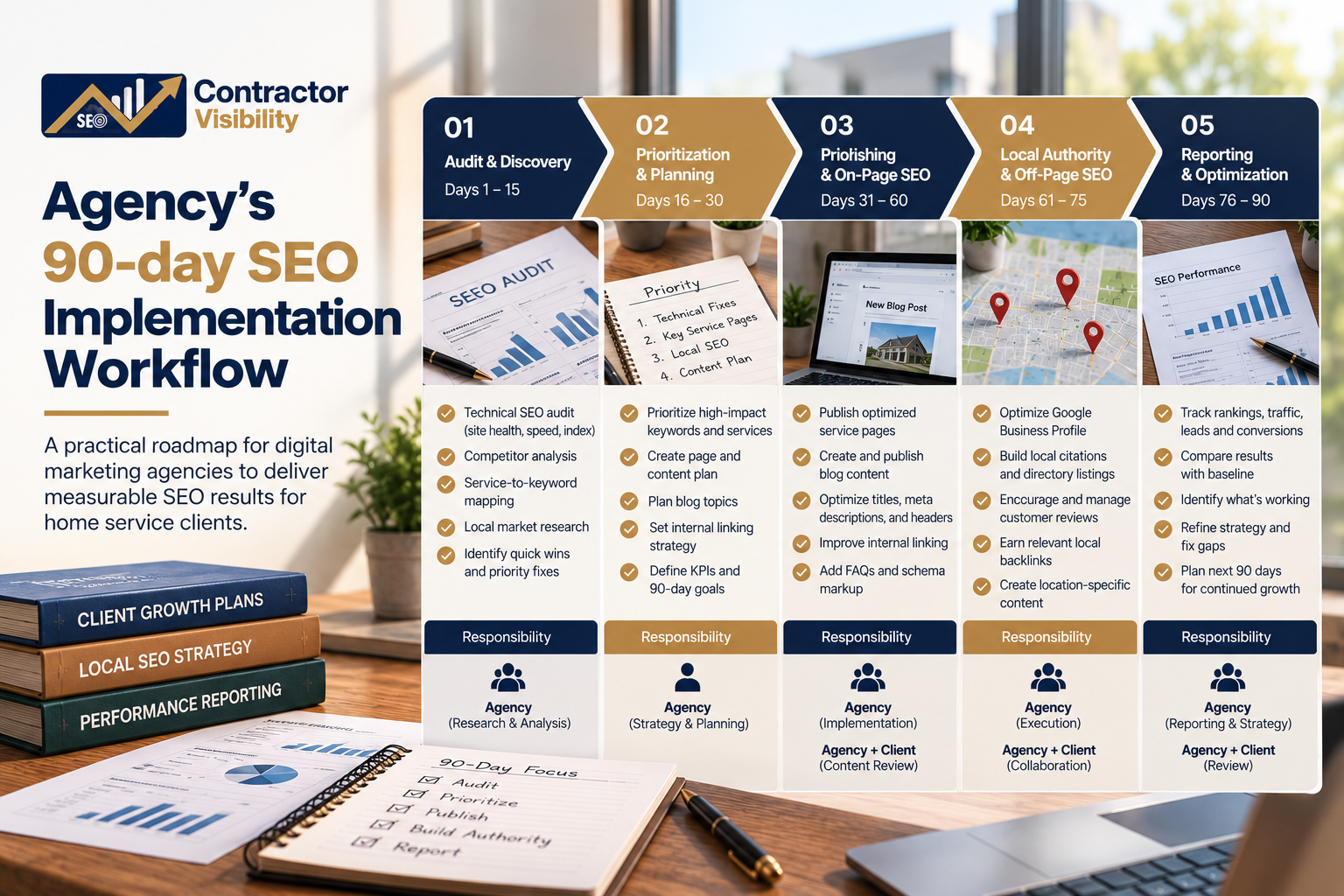
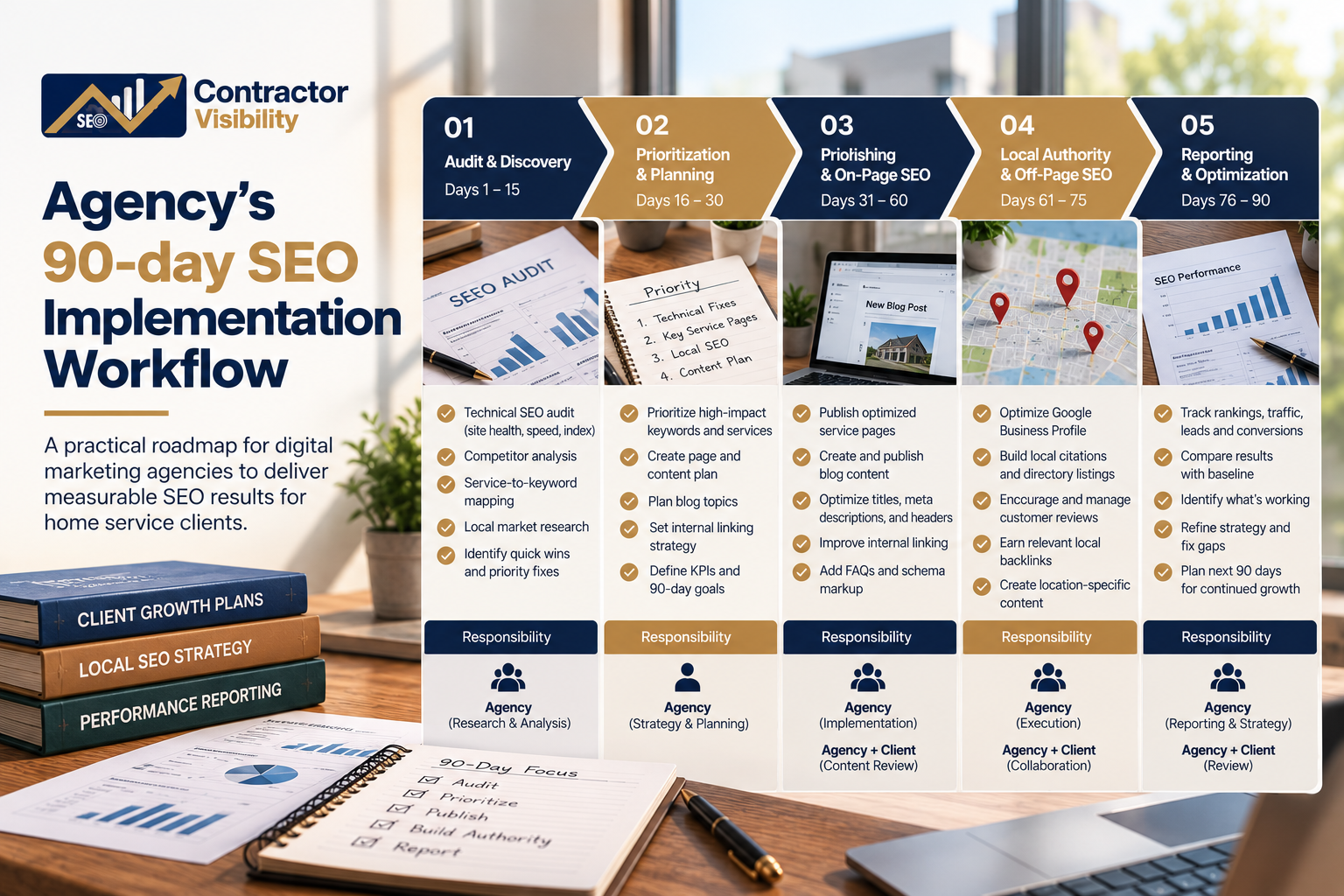
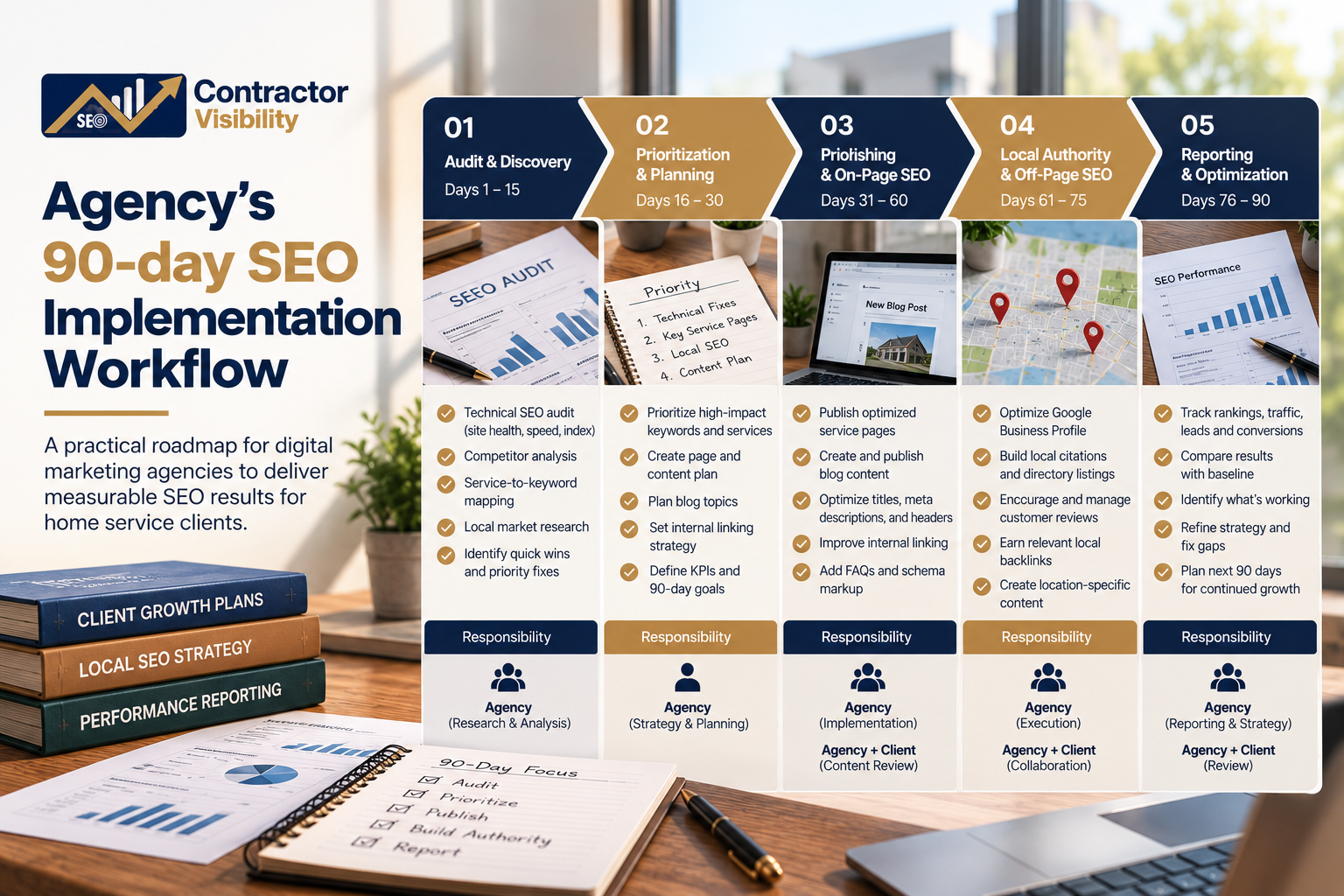
A practical 90-day agency workflow
Days 1–30: confirm service economics, establish access and baselines, validate tracking, audit technical blockers, map keywords to URLs, and correct critical business profile information.
Days 31–60: improve the highest-value service pages, repair mobile conversion issues, implement a compliant review request process, and publish the first high-intent support pieces.
Days 61–90: add real local proof, pursue relevant authority opportunities, complete the supporting content cluster, compare lead quality with baseline, and agree on the next quarter’s priorities.
Common mistakes worth catching early
- Publishing dozens of near-identical city pages without local evidence.
- Reporting rankings and sessions without checking whether calls are qualified.
- Promising 24/7 response or same-day availability the contractor cannot provide.
- Treating GBP categories, reviews, and service coverage as set-and-forget tasks.
- Writing cost and safety advice without regional or licensed-expert review.
- Buying low-quality links or fabricating testimonials, certifications, or case studies.
Conclusion
The strongest home service SEO programmes are built around a contractor’s real service mix, geographic reach, and capacity. Accurate local signals, helpful service pages, technical reliability, trustworthy proof, and disciplined lead measurement work together. None of them replaces the others.
If your agency is managing HVAC, plumbing, roofing, or other contractor accounts and needs a clearer execution process, explore Contractor Visibility’s home service SEO support or request a consultation. Bring one client’s priority services, target cities, and recent lead-quality data; those three inputs are enough to start a useful conversation.