 Madison Hayes
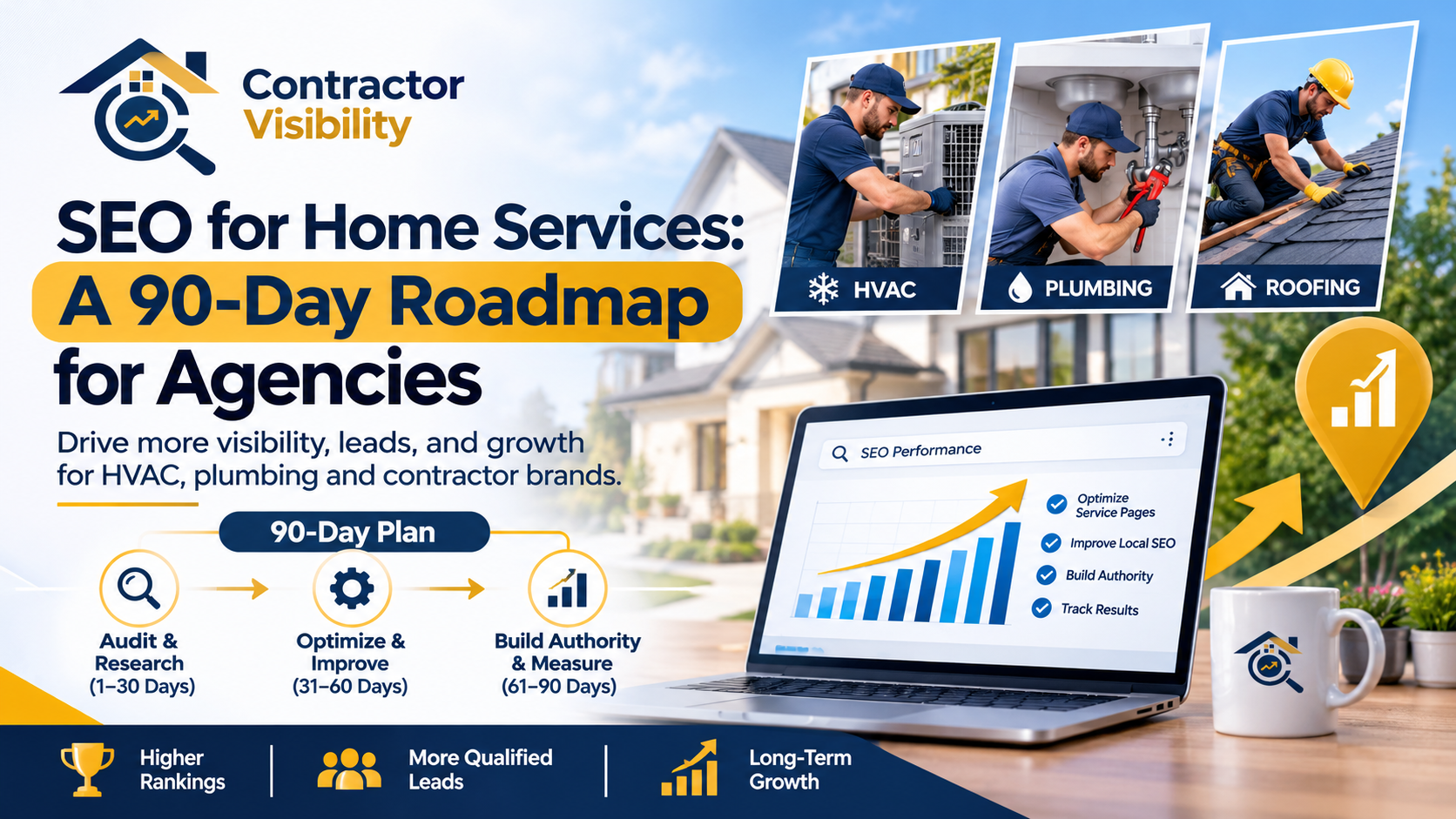
A new HVAC, plumbing, roofing, or contractor SEO client may have service pages to improve, an incomplete Google Business Profile, unreliable conversion tracking, or competitors with stronger local visibility. Agencies need to identify the highest-impact work, implement it in the right order, and report progress without promising rankings.
A structured 90-day roadmap connects technical SEO, local visibility, commercial pages, content, authority, and lead tracking.
What Is SEO for Home Services?
SEO for home services improves a contractor's visibility when customers search for services within its coverage area. It includes technical SEO, keyword research, service-page optimization, local SEO, content, reputation management, link earning, and conversion optimization.
An HVAC company may target "AC repair in Phoenix" or "heat pump installation," while a plumber may prioritize "emergency plumber" or "water heater repair." The goal is to attract relevant visitors who need the service, live within the service area, and may become qualified leads—not simply to increase traffic.
Why Different Trades Need Different Strategies
SEO should reflect the service, customer urgency, project value, and location.
HVAC: Demand changes seasonally. Prioritize AC repair, installation, furnace repair, heat pumps, and maintenance pages. Publish seasonal content ahead of peak demand.
Plumbing: Customers may search urgently for leaks, clogged drains, or water-heater problems. Clearly communicate services, availability, service areas, and next steps. Make contact options easy to use on mobile.
Roofing and other contractors: Customers compare costs, materials, qualifications, reviews, warranties, timelines, and previous work. Use genuine project photos, testimonials, and clear service explanations to build trust.
What Agencies Should Prioritize Before Scaling
Before producing large volumes of blogs or backlinks, confirm that measurement, website accessibility, and commercial pages are in place.
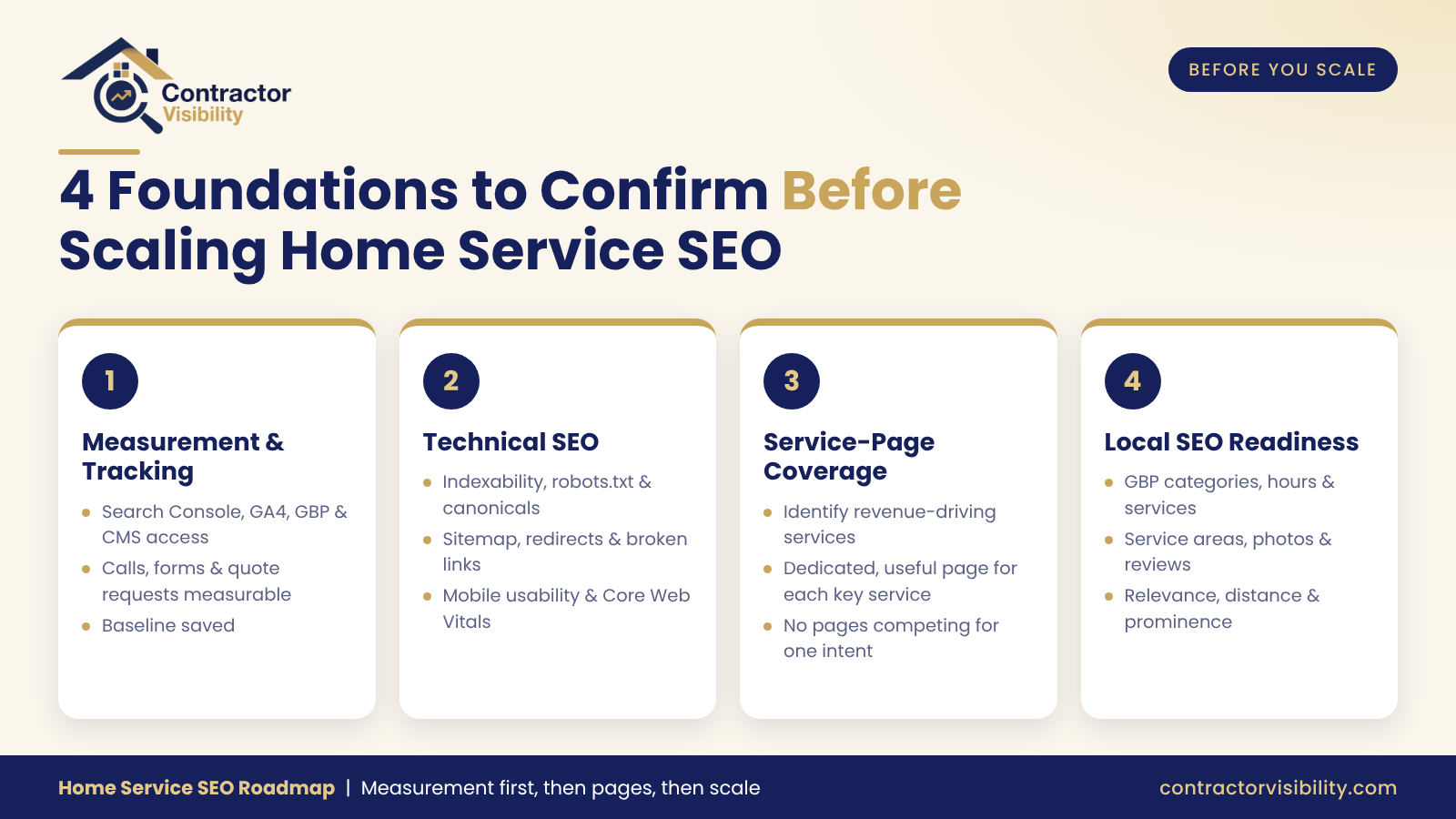
1. Measurement and conversion tracking: Confirm access to Google Search Console, GA4, Google Business Profile, the CMS, and call tracking where applicable. Check whether calls, form submissions, and quote requests are measurable. Establish a baseline if historical data is unavailable.
2. Technical SEO: Review indexability, robots.txt, noindex directives, canonicals, XML sitemap, redirects, broken links, internal linking, mobile usability, Core Web Vitals, and HTTPS. Prioritize issues by impact.
3. Commercial service-page coverage: Identify services that generate revenue or match growth priorities. Ensure important offerings—such as AC repair, water heater installation, roof replacement, or electrical panel upgrades—have useful dedicated pages.
4. Local SEO readiness: Review Google Business Profile categories, business details, hours, services, service areas, photos, and reviews. Google says local results are influenced mainly by relevance, distance, and prominence. Agencies can improve relevance and online presence but cannot control distance or guarantee rankings.
Prioritizing SEO Tasks
Evaluate tasks by business impact, search opportunity, urgency, confidence, and effort.
Priority Score = (Business Impact + Search Opportunity + Urgency + Confidence) ÷ Effort
Score each factor from 1 to 5. This is an internal planning tool, not an industry-standard formula. Fixing a blocked service page or improving a mobile call-to-action may take priority over a generic blog or dozens of thin location pages.
Days 1–30: Audit, Research, and Build the Foundation
Week 1—Onboarding: Confirm goals, priority services, service areas, seasonal needs, lead sources, website access, tracking, approval process, and reporting expectations. Save a baseline.
Week 2—Technical audit: Review indexability, crawl access, broken URLs, canonicals, redirects, internal links, mobile usability, and performance. Create an issue log with the affected URL, evidence, recommended fix, priority, owner, and status.
Week 3—Local SEO and competitors: Review the Google Business Profile and compare three to five local competitors. Assess service pages, coverage, reviews, content, project evidence, trust signals, and conversion paths. Use research to find opportunities, not copy competitors.
Week 4—Keyword research and page mapping: Group terms by service, location, and intent, then assign them to appropriate pages.
Avoid creating multiple pages that compete for the same intent without a clear reason.
Day-30 deliverables: Baseline report, technical and local audits, keyword research, page mapping, competitor analysis, and prioritized roadmap.
Days 31–60: Optimize Commercial Pages and Local Visibility
1. Optimize service pages. Explain the service, problems it solves, when customers may need it, the company’s process, service areas, trust signals, and contact options. Optimize titles, meta descriptions, headings, content, internal links, images, relevant structured data, and CTAs. Write to meet customer needs—not an arbitrary word count.
2. Improve location pages. Include useful details such as services available, real projects, testimonials, photographs, coverage, or local context. Avoid mass-producing near-identical pages with only city names changed; they may provide little value and create doorway-page concerns.
3. Optimize Google Business Profile. Verify details, categories, hours, services, photos, and service areas. Eligible service-area businesses that do not receive customers at their address should hide that address and specify service areas. Establish an honest review-request process and respond professionally.
4. Publish supporting content. Develop articles around real services and customer questions, such as "Should You Repair or Replace Your Air Conditioner?", "Signs Your Water Heater Needs Replacement," or "Roof Repair vs. Replacement: How to Decide." Link naturally to relevant service pages.
5. Improve mobile conversions. Check phone visibility, click-to-call, forms, loading performance, readability, navigation, CTA placement, trust signals, and quote-request process.
Day-60 deliverables: Optimized service pages, improved location pages and internal links, GBP updates, review workflow, supporting content, mobile improvements, and progress report.
Days 61–90: Build Authority and Refine Performance
1. Earn relevant authority. Explore legitimate opportunities through local associations, trade organizations, suppliers, community sponsorships, industry publications, local news, partnerships, and useful resources. Prioritize relevance and editorial quality over bulk link volume.
2. Improve content using search data. Use Search Console to review queries, clicks, impressions, CTR, new terms, content gaps, and pages that attract traffic but do not convert. Relevant impressions with low CTR may call for better titles or descriptions; traffic without leads may require stronger service information, trust signals, or clearer CTAs.
3. Review lead quality. Where tracking is available, evaluate calls, forms, qualified inquiries, appointments, booked jobs, and revenue. Ask whether leads are relevant, calls are answered, inquiries come from target areas, and the business has capacity.
4. Plan the next quarter. Use results to prioritize service-page expansion, location coverage, seasonal content, internal links, relevant link earning, conversion improvements, content updates, and new services.
90-Day Campaign Roadmap
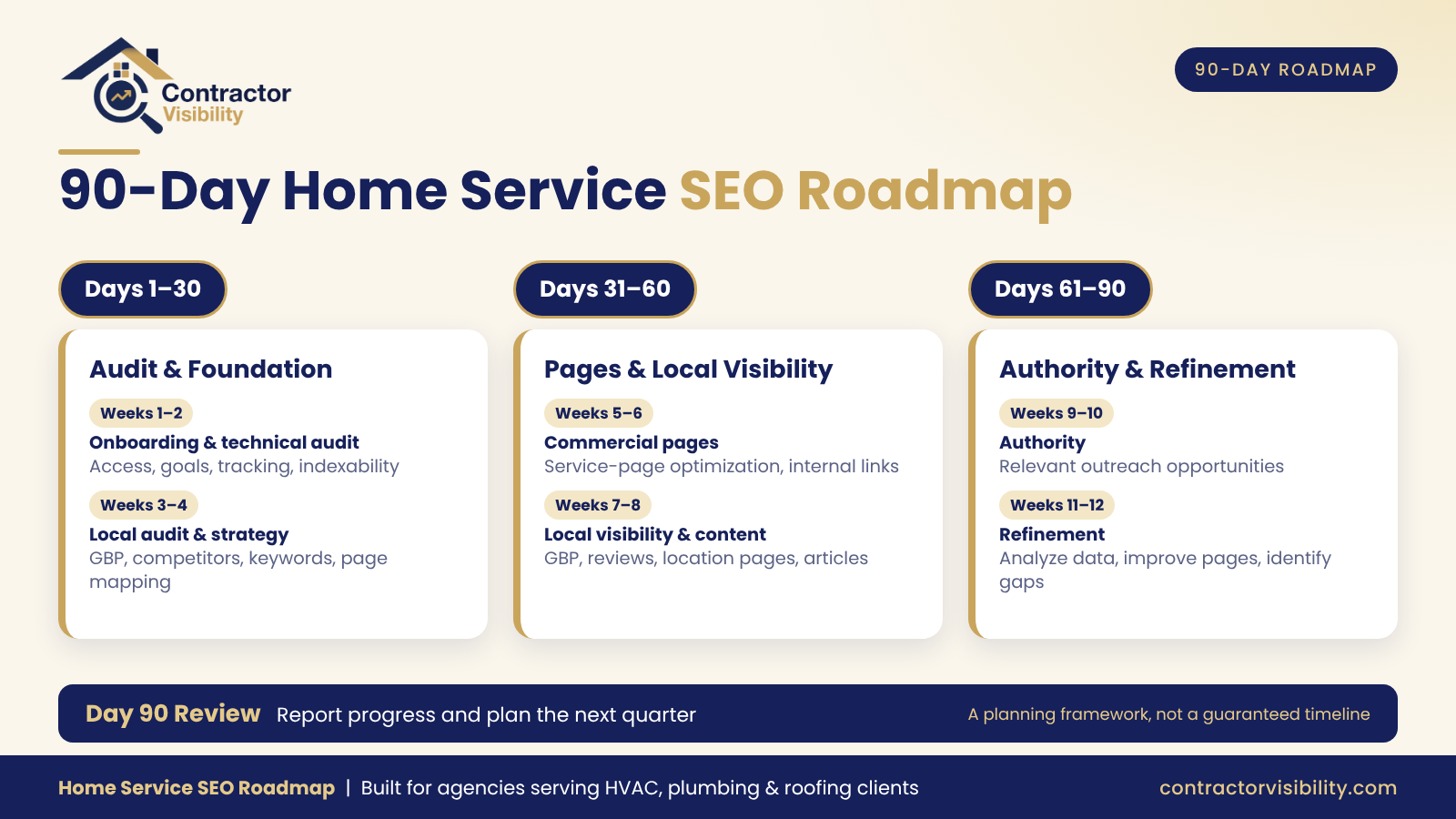
This is a planning framework, not a guaranteed timeline. Client approvals, developers, content review, and external resources can affect implementation.
What Agencies Should Report
Month 1—Foundation: Baseline metrics, technical findings, indexing, keyword research, GBP audit, competitor analysis, roadmap, and quick wins.
Month 2—Implementation: Pages updated, content published, GBP changes, review workflow, indexing status, early impressions and clicks, and tracking status.
Month 3—Performance: Visibility, traffic, landing-page performance, measurable leads, links earned, deliverables, opportunities, and next-quarter plan.
Separate visibility (impressions and rankings), engagement (clicks and CTR), website performance (sessions), lead activity (calls and forms), lead quality, and business results (jobs and revenue). More impressions do not automatically mean more revenue; explain attribution limitations.
Quality Control and Common Mistakes
Before publishing, verify search intent, client facts, keyword-page alignment, titles and descriptions, headings, internal links, claims, readability, images and alt text, and CTA placement. Technical QA should check URL, status code, indexability, canonical, mobile usability, schema where relevant, sitemap, and forms or phone links.
Avoid publishing blogs before commercial pages are ready, using the same strategy for every trade, creating thin location pages, ignoring conversion tracking, buying irrelevant links, reporting rankings without business context, treating day 90 as the finish line, or failing to track client approvals and dependencies.
Frequently Asked Questions
What is SEO for home services? It improves contractors' search visibility for relevant services in their coverage areas through technical SEO, local optimization, service pages, content, authority, and conversion improvements.
How long does SEO take? Timing depends on competition, location, website history, technical condition, and execution. Visibility may improve before leads; sustained work is generally needed over several months.
What should agencies prioritize in the first 90 days? Measurement, technical SEO, keyword research, Google Business Profile, high-value service pages, local visibility, supporting content, and relevant authority building.
Do home-service businesses need a blog? Not necessarily first. Establish service pages and local visibility, then use articles to answer customer questions and support commercial pages.
How many location pages are needed? There is no universal number. Create pages for genuine service areas only when each can offer distinct, useful information.
Build a Repeatable SEO Fulfilment Process
A 90-day roadmap is not a promise of rankings. It is a structured approach to improving a contractor’s website and local presence while measuring progress.
Agencies should begin with measurement, resolve important technical issues, optimize valuable service pages, improve local visibility, and build relevant authority. The strategy should reflect the client’s services, locations, customers, and business priorities.
For agencies managing multiple contractor clients, a repeatable process makes SEO easier to prioritize, deliver, measure, and scale.
Contractor Visibility provides white-label support across content writing, local SEO, technical SEO, link building, and AI search visibility. Explore our white-label content writing services or home-service SEO solutions to learn how fulfilment support can fit into your agency workflow.